
Curriculum links:
- Physics – Forces – Investigating the law of floatation – How things like ships and submarines float or sink
- Art – Origami
Learning objectives:
- Air pressure and force
- How boats float
- How diving bells work
- How folds in paper give rigidity.
Materials:
- A4 sheet of paper
- Large container or sink
- Smaller container or glass that the boat will fit into
Safety:
- Make sure the children are not left alone with water
- Younger children may find it difficult to reach into the box and will need assistance.
Instructions:
Making a boat
This is a nice and simple setup but there’s a load of science to be found in it as well as some great dexterity work. Even if children learn about folding and the strength it gives paper then mission accomplished!
Paper is very weak when it is compressed or squeezed together but is stronger when it’s pulled apart. By putting a fold in it you create a “thickness” which allows the paper to reinforce itself and not collapse so easily.
Here’s a link to some instructions on how to make the boat – but if you want to do this experiment quicker, anything that floats will work. https://www.youtube.com/watch?v=PzBCCyUf3VY
Getting the boat underwater without getting it wet!
Place an air tight container/glass (big enough to fit over the boat) over the boat. Push the container/glass further down into the water and watch the boat continue to sail in the container but under the water outside the container.
How it works:
Why do boats float again and how did you do that trick?
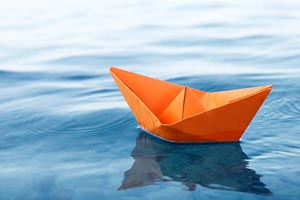
Firstly, it’s not a trick – its science! Secondly boats will float if their shape pushes away more water than they weigh i.e. they are less dense that the water that surrounds them. Imagine a blown-up balloon. It weighs next to nothing compared to its size (the amount of water it pushes away) so it floats on water. A boat is the same if the hull, pushes away more water than the weight of the boat – it floats! Which is why our paper boat sits proudly on the top of the water in the tank.
The “trick” to get the boat to go underwater without getting wet is to have an air tight container big enough to fit over it. Air is made up of matter and therefore takes up space. When you pop the container down over the boat it is filled with air. Air is less dense than water so it wants to rise up in it (picture how a bubble behaves) so it stays inside the container/glass. As there is air already inside the container with no way of getting out, the water below can’t force its way in so the boat floats on the water that’s below it and hence you can get your ship to sail underwater. This is the exact way that diving bells work and how workers used them to engineer a lot of the infrastructure and buildings in water.





 suitescience.ie