
Curriculum links:
- Chemistry – Chemical energy – Heat – To become aware of the practical application of carbon dioxide in our daily lives.
Learning objectives:
- Understand fire and what is needed for it
- Take our understanding and predict how we might extinguish fires
- Learn about chemical reactions and their daily lives
Materials:
- 3 Tablespoons of baking soda
- A jug
- 300ml of vinegar
- A piece of paper or card
- A tea light
- A lighter or match
Safety:
- This is a pretty straight forward experiment and as such it may try lull you into a false sense of security. Please do not let it. Any experiment or demonstration with fire is dangerous and everyone should be careful. One single candle is enough to burn or even ignite a head of hair full of hairspray. So take no chances either way.
Instructions:
- Put 3 tablespoons of baking soda into a container with high walls – a jug works best.
- Next add 300ml of vinegar. Normal distilled vinegar will work, it doesn’t matter if it is white or brown. (You’ll use smaller amounts for smaller containers)
- Watch all the fizz and bubbles come up to the top of the glass.
- Put a small piece of paper or card at the top to stop the flow of air over the top.
- Next – ask for help and get an adult to light a tea light
- Once you’re happy and the bubbles have dropped down, pour the C02 in the glass over the candle. Note: you don’t pour the liquid. The C02 is an invisible gas that is heavier than air so it’ll come out and onto the candle.
- You can repeat the experiment by lighting the candle again with permission
How it works:
Baking soda is a base and vinegar a weak acid. When they get mixed together, the immediate reaction creates carbonic acid. However, carbonic acid is very unstable and it quickly decomposes into carbon dioxide (CO2) and water (H2O). There was so much of it, in fact, that it pushed all other gasses out of the container and filled it completely. Since CO2 is heavier than air, the container was filled with it and nothing else. As you tilt the container, you literally pour the CO2 onto the flame. That means air can’t get to the flame and it goes out for lack of oxygen.
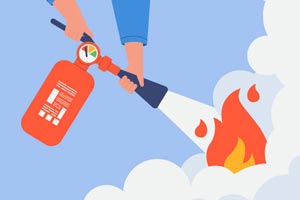
Have a look around your school and see if there are any fire extinguishers that have CO2 written on them.
What is fire?
Fires start when a flammable and/or a combustible material with an adequate supply of oxygen is subjected to enough heat. For a fire to exist it requires three elements to be in place Heat, Oxygen and Fuel. This is known as the Fire Triangle.
The triangle shows what you need to ignite and burn a fire. Removing any one of them means that the fire goes out. Without enough heat, a fire cannot start, and it cannot continue. So pouring water on a fire can help.
Without fuel, a fire will stop. Therefore, moving things that can burn away from the fire can help stop the spread. Without enough oxygen (0₂), a fire cannot begin, and it cannot continue. So replacing the oxygen with something else can stop the fire. Carbon dioxide (CO₂) is a gas that humans interact with every day. Sure, you exhale it from your lungs and plants use it to make food. It’s heavier than air and we can use it to extinguish certain types of fires.





 suitescience.ie